Python MCP Server Connecting Claude to a Field-Service CRM
A hosted, OAuth-protected MCP server in Python that lets a home-services business ask Claude about customers, jobs, invoices and leads, with write actions hidden unless allowed.
Python Automation
Works with
Python
FastMCP
OAuth 2.0
REST API
Railway
Claude
The Problem
A home-services business wanted to ask Claude questions about customers, jobs, invoices and leads, and to take safe actions, without giving it raw database access.
The Solution
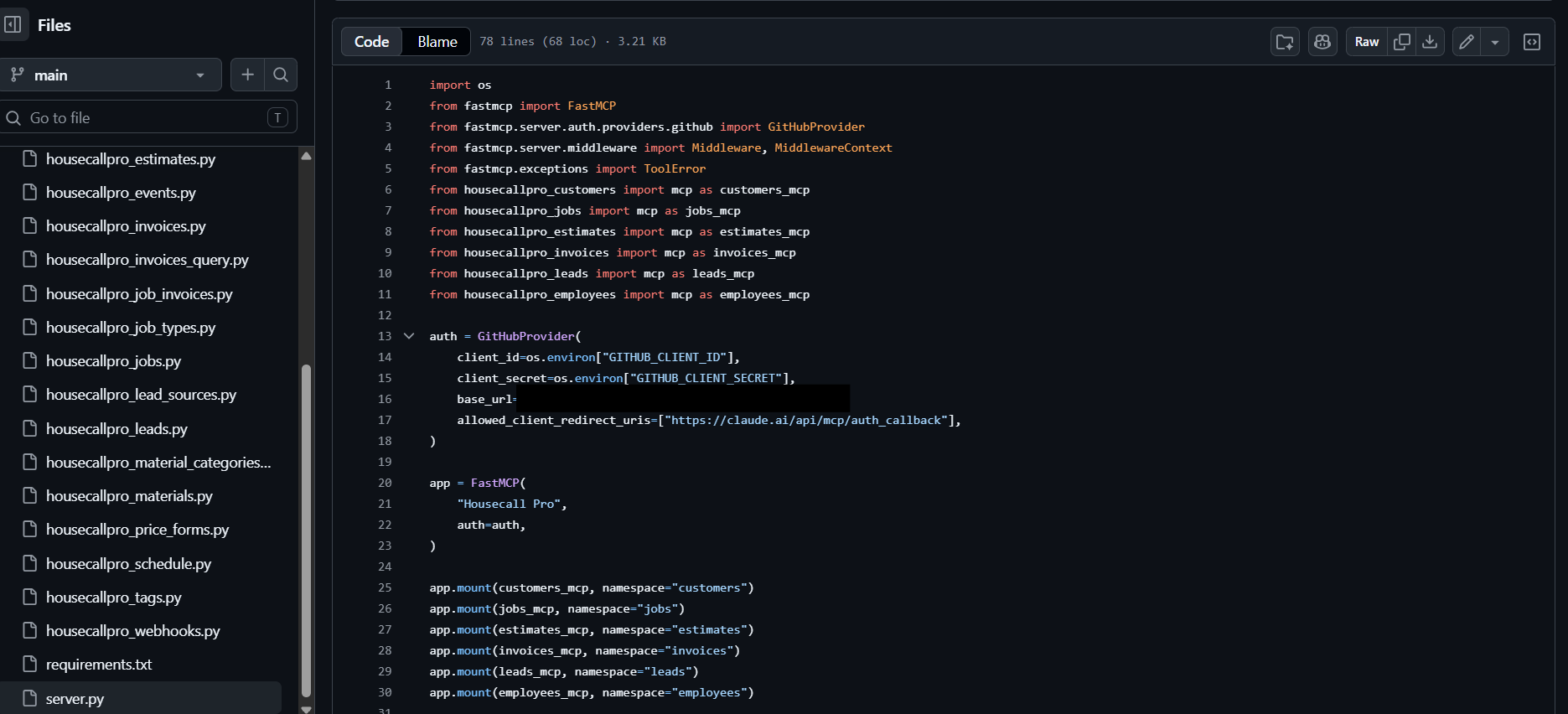
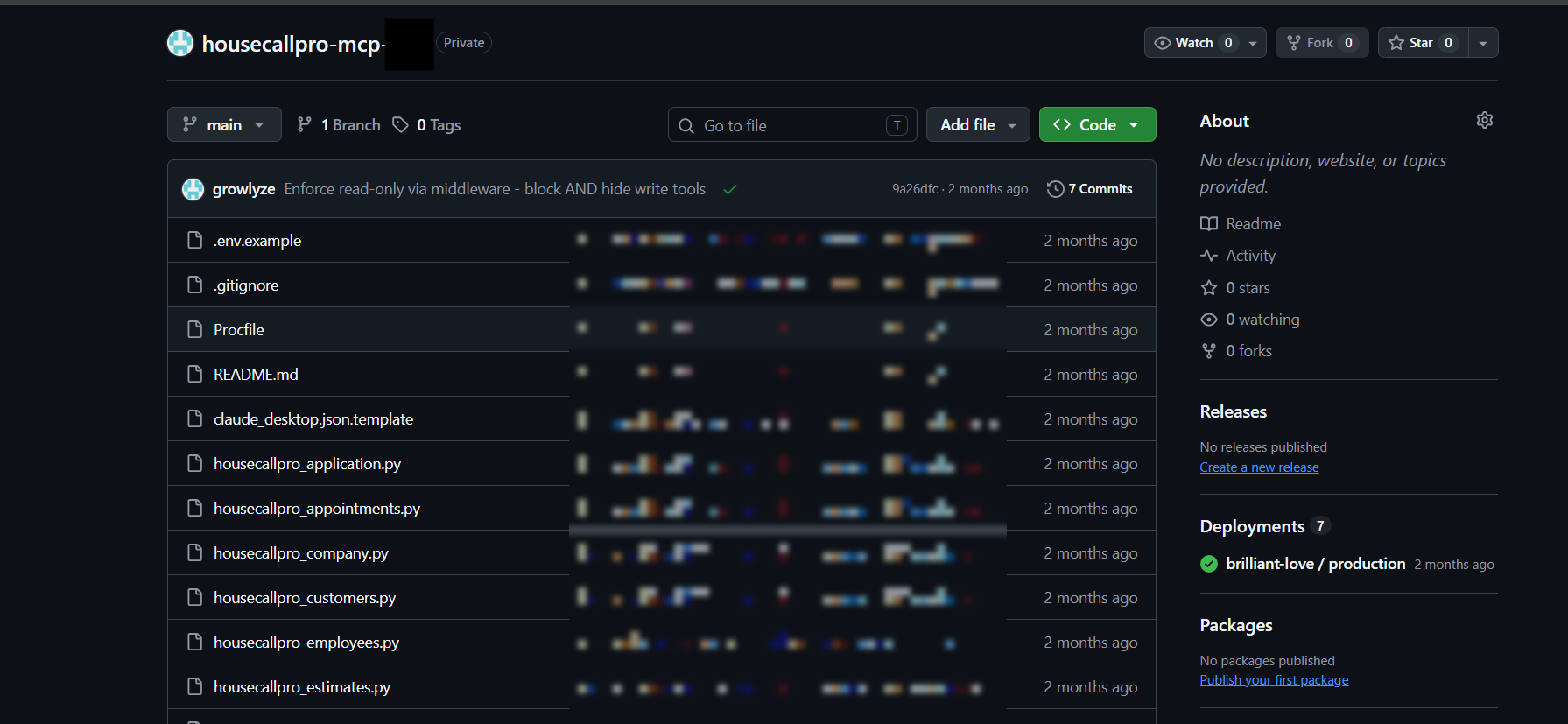
A Model Context Protocol server that exposes the full REST API of the business’s field-service software (Housecall Pro) as about 20 domain modules: customers, jobs, estimates, invoices, leads, employees, scheduling, webhooks and more. They are all mounted under one FastMCP app. It is deployed on Railway and connects straight into claude.ai.
Notable details
OAuth login sits in front of the server (GitHub provider, redirecting back to claude.ai), so no shared API keys are handed to users.
A read-only enforcer middleware hides every tool whose name contains create, update, delete, send, void or dispatch from the tool list, unless it is explicitly allowed. This is per-agent permission control at the protocol level.
Tools are namespaced (customers_*, jobs_*, invoices_*), so the model cannot confuse one domain with another.
The server entry point: GitHub OAuth in front, one FastMCP app, and each domain module (customers, jobs, estimates, invoices, leads, employees) mounted under its own namespace.The repository: one Python module for each area of the field-service API, plus a Procfile for deployment on Railway. The commit messages are blurred.
 Python Automation